The Chancellor’s Budget statement comes at a time when the UK has seen six Chancellors in just five years, reflecting a period of political and economic change that has left businesses and investors alike calling for certainty and stability in the tax system. Against this backdrop, the Chancellor described the statement as a Budget for working people and businesses.
The Budget contains a number of targeted measures aimed at supporting households and smaller businesses. The extension of the 0% VAT rate on domestic electricity until July 2027 will benefit households, charities and care providers, while the increase in the Small Business Rates Relief threshold from £12,000 to £18,000 provides welcome support for smaller businesses. The Government has also shifted VAT compliance obligations to online marketplaces, helping to create a more level playing field for UK businesses, while import tariffs on more than 100 products have been removed.
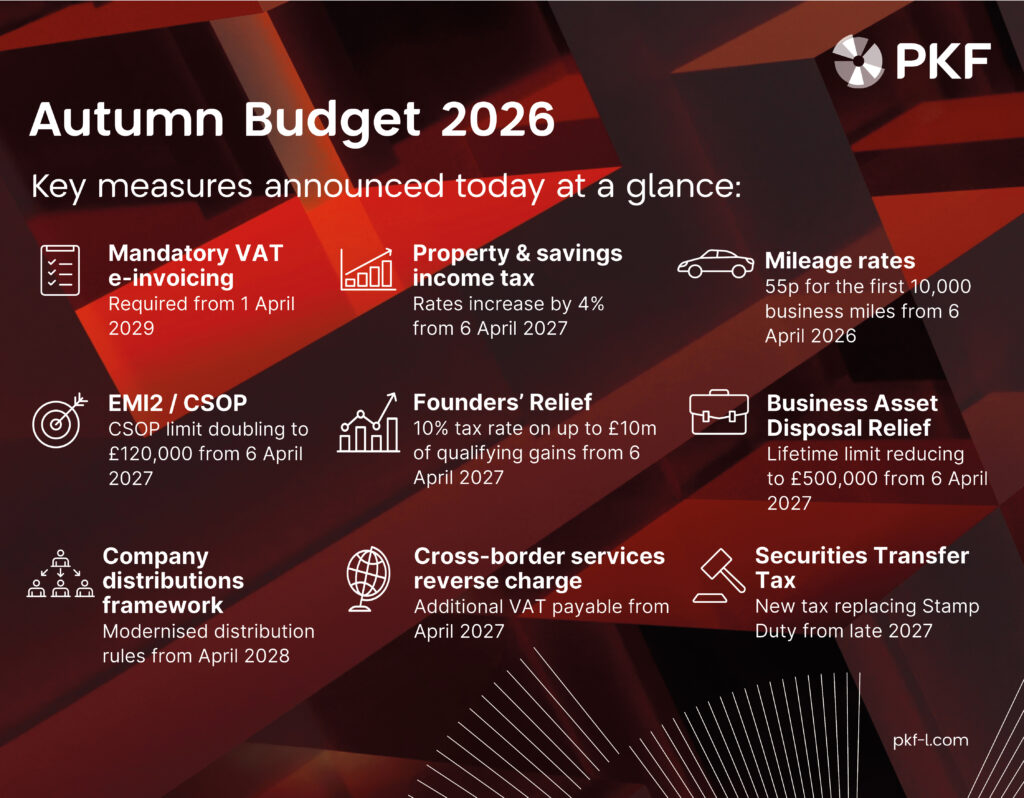
The Budget also includes several structural tax changes. A new pensioners’ personal allowance has been announced, while Business Asset Disposal Relief will be restricted through a reduction in its lifetime limit from £1 million to £500,000 from April 2027, partially offset by the introduction of Founders’ Relief – although little detail has been announced on this today. The move to regular Self-Assessment payments from 2029 signals a shift towards a PAYE-style approach for the self-employed, landlords and investors, while the doubling of the CSOP share option limit to £120,000 strengthens availability of tax efficient employee share ownership arrangements for companies too large to use EMI.
The Chancellor concluded by describing this as a Budget focused on stability and direction, a theme reflected in a package that favours targeted reform over wholesale change.
You may also like
-

Autumn Budget 2026: our summary
2min read
Explore the main announcements from the Chancellor’s Budget, including tax reforms, VAT measures, business support and changes for investors, landlords and the self-employed.
-

Autumn Budget 2026: Your capital
2min read
Explore the key business tax changes announced in Budget 2026, including Business Asset Disposal Relief, Founders’ Relief, ISAs, share schemes and company distribution reforms.
-

Autumn Budget 2026: Your business
2min read
Explore the Autumn Budget 2026 business tax changes and their impact on investment incentives and allowances coming in 2027.


Contact our experts
Contact our experts