

In the second article of a three-part series, Senior Manager, Cezar Dumlao uses a simplified mortgage example to demonstrate how the effective interest rate (EIR) method operates in practice and how revisions to expected cash flows can give rise to cumulative catch-up gains and losses.
Introduction
In the previous article, we explored the key differences between IFRS 9.B5.4.5 and B5.4.6 and their impact on the accounting for floating-rate mortgage instruments. This article examines how those requirements apply in practice, using a simplified mortgage example to illustrate effective interest rate (EIR) calculations, revisions to expected cash flows and cumulative catch-up adjustments.
This article uses a simplified floating-rate mortgage example to illustrate the application of the effective interest rate (EIR) method under IFRS 9 and how revisions to expected contractual cash flows can result in cumulative catch-up adjustments.
A simplified mortgage example
Consider a mortgage lender that originates a residential mortgage with the following characteristics:
- Principal balance: £1,000,000
- Upfront arrangement fee: 7% (£70,000)
- Initial carrying amount: £930,000
- Initial fixed interest rate: 5% for the first year
- Subsequent interest rate: Floating rate linked to market conditions
- Repayment profile: Bullet repayment at maturity.
At origination, the lender calculates an effective interest rate (EIR) of approximately 6.7%, incorporating both contractual interest and the upfront arrangement fee. The fee is subsequently amortised through interest income over the expected life of the mortgage.

Year 2: Higher interest rates and revised cash flows
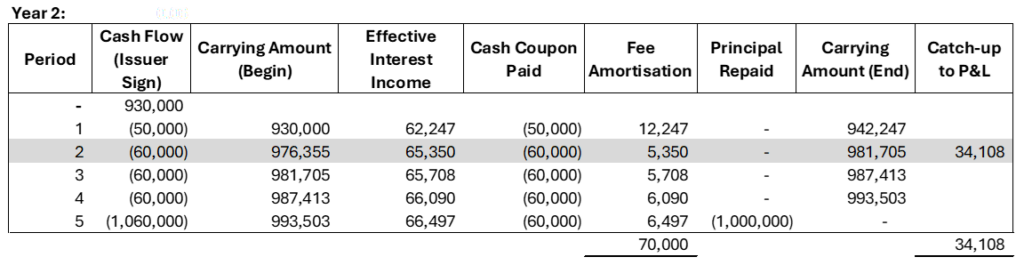
At the beginning of Year 2, market interest rates increase and the contractual floating rate resets from 5% to 6%. Management also revises its expectations regarding the remaining cash flow profile, including the period over which the upfront fee is expected to be recovered.
As a result:
- Expected future cash flows increase
- The change is assumed to be broader than a simple contractual market-rate reset
- The revised cash flows are discounted using the original EIR of 6.7%.
Because the present value of the revised cash flows exceeds the existing carrying amount, the lender recognises an immediate cumulative catch-up gain in profit or loss.
Year 3: Lower interest rates and revised cashflows
In Year 3, market rates decline and the contractual floating rate resets from 6% to 4%. Management again revises its expectations regarding future cash flows.
As a result:
- Expected future cash flows decrease
- The revised cash flows continue to be discounted using the original EIR.
This time, the present value of the revised cash flows is lower than the carrying amount, resulting in an immediate cumulative catch-up loss recognised in profit or loss.

Balance sheet impact
If the rates stayed the same in the subsequent years, the balance sheet presentation would be:
|
Balance sheet (Year 4): |
|
|
Mortgage loan |
£1,000,000 |
|
Less: deferred fees (£48,902 – £23,659) |
£25,243 |
|
Net mortgaged loans |
£974,757 |
|
|
|
|
Balance sheet (Year 5): |
|
|
Mortgage loan |
£1,000,000 |
|
Less: deferred fees (£25,243 – £25,243) |
|
|
Less: full repayment |
£1,000,000 |
|
Net mortgaged loans |
|
Why IFRS 9.B5.4.6 creates cumulative catch-up adjustments
Under IFRS 9.B5.4.6, revisions to expected contractual cash flows are measured using the original effective interest rate (EIR), which can result in immediate cumulative catch-up gains or losses.
The accounting impact is often more significant where mortgages contain:
- integral fees
- premiums
- discounts.
How IFRS 9.B5.4.5 differs
Rather than recognising an immediate gain or loss, IFRS 9.B5.4.5 generally reflects changes arising from market-rate movements prospectively through a revised effective interest rate and future interest income recognition.
As a result:
- B5.4.5 generally spreads the effect over the remaining life of the instrument
- B5.4.6 may result in an immediate catch-up adjustment
- Similar economic events can therefore produce very different accounting outcomes depending on the facts and circumstances.
Key takeaway
The distinction between IFRS 9.B5.4.5 and B5.4.6 can have a significant impact on profit recognition, carrying amounts and mortgage fee amortisation. Applying the appropriate guidance depends on the nature of the change in expected contractual cash flows.
How PKF can help with IFRS 9 effective interest rate challenges
Applying IFRS 9 to EIR modelling, cash flow forecasting and catch-up adjustments can be complex. PKF’s financial reporting and IFRS experts can help lenders develop clear methodologies, robust models and produce audit-ready documentation that supports consistent application across portfolios.
- Audit and assurance insights
Drawing on our extensive experience auditing IFRS 9 models and financial instruments, we provide practical insight into the areas that typically attract auditor and regulatory scrutiny. This helps clients strengthen their methodologies, evidence key judgements and prepare for audit challenges before they arise. - Audit-ready documentation
We support the development of clear and comprehensive audit trails, from modelling assumptions and testing procedures to management overlays and responses, helping to streamline year-end audits and reduce the risk of findings. - Process design and controls
We assist in designing and implementing robust processes and controls around EIR modelling, data inputs, and cash flow projections, embedding governance into day-to-day operations. - Model validation and governance
Whether using internally developed models or third-party tools, we help strengthen model validation frameworks, ensuring they are consistent, well-documented, and aligned with audit expectations. - Strategic insight and impact analysis
We help interpret model outputs and assess their impact on financial performance, provisioning, and reporting, translating technical results into actionable insights for management.
Contact PKF’s financial reporting and IFRS experts to discuss your IFRS 9 accounting challenges and develop an audit-ready approach tailored to your mortgage portfolio.
Speak to our expert team today to discuss your IFRS accounting challenges.
You may also like
-

IFRS 9 impairment: what you should consider
5min read
Which IFRS 9 impairment considerations apply to related company loans? How do you apply expected credit losses? And how should you present related company loans in your financial reports?
-

IFRS 9: the two ways of calculating ECLs
5min read
Since IFRS 9 replaced IAS 39, entities have been getting to grips with new reporting requirements. We look at the methods and considerations along the way.
-

Significant increase in credit risk (SICR): getting staging right under IFRS 9
5min read
Strengthen your SICR framework under IFRS 9 with better staging, governance and forward-looking credit risk assessments.